


Why Might Molded Pulp Be the “Only” Option in the Future?
Sep 15, 2026
Leave a message
B2B Procurement Dilemma: Compliance vs. Aesthetics
For procurement managers in the consumer electronics, beauty, and specialty food industries, choosing the right packaging inserts is always a high-stakes trade-off:
On the one hand, cross-border shipping faces increasingly stringent regulations in the EU and North America, and traditional plastic inserts often fail to clear customs or trigger hefty plastic taxes.
On the other hand, high-end retail gift boxes require a certain level of texture and structural strength, which inexpensive paper or foam simply cannot provide.
Take the example of one of our recent European beauty clients: They initially used transparent thermoformed inserts for their lipstick product line. Upon arrival in Europe, the shipment was detained by customs for violating the ban on non-biodegradable materials and strict EPR (Extended Producer Responsibility) requirements, resulting in high port demurrage fees and compliance fines. After switching to sugarcane bagasse pulp-molded inserts, they cleared customs without issue.
Similarly, a high-end digital brand switched from easily deformable cardboard inserts to precision pulp-molded inserts, reducing the shipping damage rate from 8% to 0.3% while significantly enhancing the unboxing experience.
Under the latest EU PPWR (Packaging and Packaging Waste Regulation) framework, industry experts are increasingly referring to molded pulp as the "only option" for sustainable and high-end export packaging. Let's take a look at the specific performance of the six common packaging inserts shown in the image in terms of environmental compliance and aesthetic appeal.Head-to-Head Comparison of Key Parameters for 6 Types of Packaging Inserts

Head-to-Head Comparison of Key Parameters for 6 Types of Packaging Inserts
Based on data from actual factory production and customer feedback, the comparative performance of molded pulp versus traditional materials is as follows:
| Insert Type | Environmental Attributes & Compliance | Maximum Aesthetics | Best Suited Scenarios | Core Defect |
| 1.Blister (PET / PVC) |
Partially recyclable, non-biodegradable. Subject to strict EPR registration requirements and a plastic tax based on weight. |
Smooth surface with a plastic sheen; edges are prone to fraying. |
Inexpensive toys, everyday retail items, and cosmetic sample sets. |
Prone to scratches; lacks a premium feel; subject to strict "plastic restriction" regulations. |
| 2.EVA ,EPE Foams |
A non-biodegradable foam plastic. Exports are subject to increasingly stringent environmental accountability and recycling certification requirements. |
It has a smooth, high-end feel, a dense texture, and supports specialized die-cutting. |
Used for high-end gift box liners, watch boxes, and jewelry boxes. |
High cost, non-recyclable, and poor environmental compliance.
|
| 3.Polylon / EPS |
Non-biodegradable. Subject to high plastic taxes in the EU and the U.S.; banned as retail packaging in many regions. |
Rough surface; can only be labeled (cannot be printed directly). Cheap, industrial appearance. |
Large home appliances, large digital devices (limited to domestic logistics cushioning). |
Poor environmental compliance; particles tend to fall off; prohibited in cross-border retail. |
| 4.Cardboard insert |
Recyclable; partially biodegradable; prone to warping when wet. |
Supports full-color printing, but the folds are prone to cracking. |
Standard cosmetic boxes and budget-friendly gift packaging. |
Low load-bearing capacity; tends to sag when loaded with more than 500 grams. Products must be folded by hand or by machine, increasing production costs. |
| 5.Honeycomb cardboard |
Recyclable, but not 100% biodegradable (contains adhesive); the original paper surface is rough. |
Cannot be printed on at all; available only in natural wood color. |
Used as padding for furniture and as cushioning material in outer packaging for bulk goods. |
Very unattractive; cannot be used for retail product displays. |
|
100% biodegradable and recyclable. Complies with EU Regulation EC 1935/2004 and U.S. FDA food contact standards. Supports FSC certification. Exempt from the plastic tax. |
Smooth surface with no rough edges. Supports flocking, lamination, printing, and hot stamping. Texture similar to ABS plastic. |
Cosmetics, consumer electronics, premium food products, and gift sets. |
Custom molds are required; the minimum order quantity (MOQ) is typically 5,000 pieces. |
As the data shows, molded pulp perfectly combines strict export compliance with high-end visual appeal.
Real-Life Cases: Avoiding Common Procurement Pitfalls
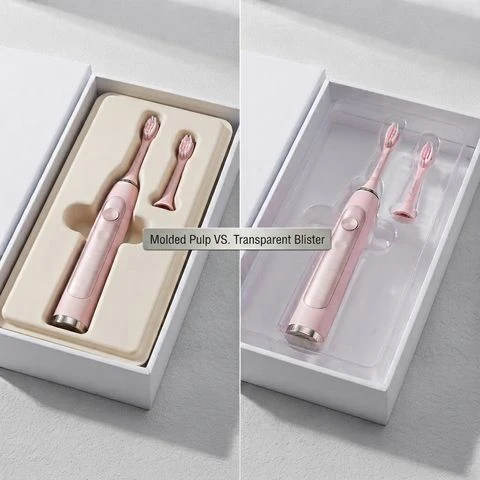
Case 1: Compliance Pitfalls in Cross-Border Electronics
client exporting electric toothbrushes to the Netherlands initially chose PET thermoformed trays to save on mold costs. During customs clearance, they were required to provide an official recycling certificate, mandatory EPR compliance certification, and pay a plastic tax penalty calculated by weight. The costs associated with compliance fines and administrative delays ultimately exceeded the cost of switching to custom pulp-molded inserts by nearly three times. They eventually had to reorganize their packaging line to comply with European standards.
Case Study 2: Upgrading High-End Retail
A gift brand experienced product shifting and scratches due to the collapse of its cardboard inserts, resulting in a customer complaint rate as high as 12%. After upgrading to custom molded pulp inserts with anti-slip ribs, the shifting issue was completely eliminated. More importantly, by printing the official biodegradable and recyclable symbols directly on the boxes, the brand increased its customer repurchase rate by 17%.

Purchasing Recommendation: If your products are intended for overseas markets or the mid- to high-end retail sector, choose pulp molding directly-do not take a chance on plastic or foam alternatives. In the long run, the costs saved by avoiding compliance fines and product returns will far exceed the initial investment in molds.
FAQ
Q: How much more expensive is molded pulp packaging compared to thermoforming or EVA?
A: The cost of molded pulp packaging is roughly equivalent to that of PET thermoforming and significantly lower than high-end EVA. Although the initial mold investment for wet-press molded pulp must be taken into account, when factoring in the elimination of plastic taxes, reduced scrap rates, and fewer damage claims, the actual total cost is typically comparable or even lower.
Q: Can pulp molding packaging be customized with printing or branding?
A: Yes. The process supports high-end four-color printing, hot foil stamping, and surface flocking. It meets standard branding requirements.
Q: Are there low minimum order quantity (MOQ) options available for market testing?
A: The standard minimum order quantity is typically 5,000 pieces; however, to accommodate clients' packaging transitions and new product launches, WEILAI offers flexible small-batch production and even custom sample services.
Q: How is the compression and cushioning performance of molded pulp inserts? Can they replace EPE pearl cotton or EPS for protecting fragile items?
A: Absolutely. Scientifically structured dry-press or wet-press molded pulp (such as those with reinforcing ribs and suspension cushioning structures) matches or even exceeds the compression and shock-absorption performance of traditional EPS or EPE foam in many mid-to-high-end product tests. At the same time, it completely avoids the environmental compliance risks associated with non-biodegradable foam plastics.
Q: Are molded pulp packages waterproof or moisture-proof? Will they soften in humid environments?
A: Standard molded pulp may absorb moisture in extremely humid environments. However, for specific demands such as beauty, high-end food, or cold-chain transportation, factories can add food-grade waterproof/oil-proof eco-friendly additives to the pulp or surface, enabling water and moisture resistance while maintaining 100% biodegradability and recyclability.
Q: What are the warehousing space advantages of molded pulp compared to traditional foam or plastic packaging?
A: Many molded pulp inserts (especially dry-press and partially nested designs) support nestability, requiring only a fraction of the warehousing space needed for bulky EPS foam boxes or large EPE pearl cotton sheets, which significantly reduces warehousing and logistics costs for enterprises both overseas and locally.
Summary: Is Pulp Molding Right for You?
If your business model meets the following criteria, pulp molding is definitely the ultimate choice:
Global Presence: Your region is part of the EU, North America, or another region with strict, mandatory "plastic-free/zero-waste" requirements under frameworks such as the EU's PPWR.
Brand Positioning: Your products fall under consumer electronics, cosmetics, personal care, or high-end retail, and require an exceptional unboxing experience..
Corporate Sustainability: Your brand actively leverages FSC certification and the circular economy narrative.
For domestic, low-end logistics shipments that do not prioritize aesthetics or export compliance, traditional corrugated cardboard or honeycomb cardboard remain viable options.
Ready to upgrade your packaging? Contact our engineering team today to receive free structural design samples and customized solutions.
Send Inquiry